Quick Answer: Lease vs Finance Decision Framework
Let me cut to the chase. After fifteen years helping Texans find the right vehicles, I’ve boiled down the lease vs finance a car decision to a few key questions.
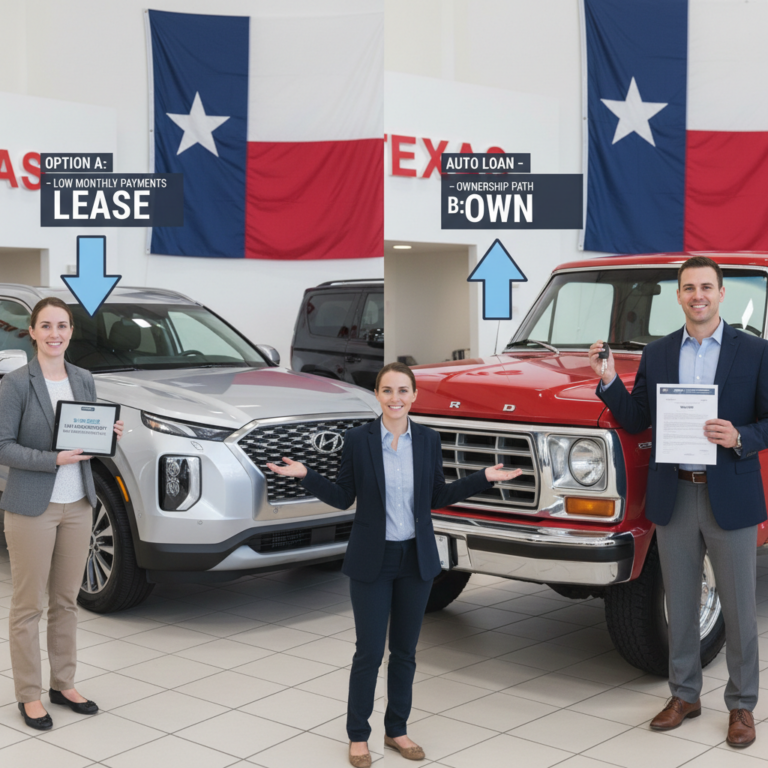
Choose leasing if: You drive under 12,000 miles yearly, want a new car every 3 years, and can handle the Texas tax quirk (more on that below). Choose financing if: You drive 15,000+ miles, plan to keep the vehicle 5+ years, or want to own something outright.
- Average lease payment: $659/month
- Average finance payment: $682/month
- Difference: About $23/month, but the real costs hide in the details
Here’s what most guides won’t tell you: Texas has a unique sales tax structure for leases that changes the math completely. I’ll break that down in a dedicated section because it’s that important for Texas buyers.
How Car Leasing Works: The Basics
Think of leasing as a long-term rental agreement with an option to buy. You’re paying for the vehicle’s depreciation during your lease term, not the full purchase price. The Consumer Financial Protection Bureau leasing guide explains the fundamentals well, but let me give you the Texas dealership perspective.
Understanding Lease Payments and Residual Value
Three numbers drive your lease payment:
- Capitalized cost: The negotiated vehicle price (yes, you can negotiate this)
- Residual value: What the car will be worth when your lease ends
- Money factor: Essentially the interest rate, expressed as a decimal
Your monthly payment covers the difference between capitalized cost and residual value, plus interest charges. A $48,000 SUV with 55% residual after 3 years means you’re paying for roughly $21,600 in depreciation plus finance charges.
Mileage Limits: What 10,000-15,000 Miles Really Means
Most leases cap you at 10,000 to 15,000 miles annually. Exceed that limit, and you’ll pay $0.15 to $0.30 per mile over. Drive 5,000 miles over on a 3-year lease? That’s $750 to $1,500 extra at lease end.
I’ve watched customers turn pale when they realized their daily Austin-to-Round Rock commute would eat through a 10,000-mile allowance by August.
End-of-Lease Options: Return, Buy, or Re-Lease
When your lease ends, you have three choices. Return the car and walk away. Buy it at the predetermined residual value. Or start a new lease on something else. The S&P Global automotive lease return insights show more people are buying out their leases in 2025, often because used car values have stayed strong.
How Auto Financing Works: Building Ownership
Financing means you’re buying the car with a loan. Each payment builds equity until you own the vehicle outright. It’s the traditional path, and honestly, it’s still the right choice for most Texas drivers I meet.
Loan Structure: Principal, Interest, and Terms
Auto loans in 2025 carry average interest rates around 7.64% for 60-month terms. That rate varies based on your credit score, down payment, and the lender. Check out our breakdown of current auto loan interest rates in Texas to see what you should aim for.
A typical 5-year loan on a $35,000 vehicle at 7.64% means paying about $40,300 total. That extra $5,300 is the cost of borrowing. But here’s the key difference from leasing: when you’re done, you own something.
Building Equity vs Lease Payments
Every finance payment builds equity in an asset you own. Every lease payment goes toward using someone else’s asset. That’s the fundamental difference.
New cars depreciate 20-30% in the first year alone. So yes, you’re underwater on a financed car initially. But by year 3 or 4, your loan balance and car value start converging. By year 5 or 6, you have an asset worth real money.
What Happens After You Pay Off the Loan
This is where financing shines. After 60 payments, you’re done. No more monthly car payments. Drive that vehicle for 3, 5, even 10 more years payment-free. I still see folks driving 15-year-old trucks they paid off a decade ago. That’s thousands saved.
CRITICAL for Texas Buyers: Sales Tax Differences You Must Know
This section alone could save you thousands. Texas has a unique and unfavorable tax treatment for vehicle leases that most national comparison articles completely ignore.
How Texas Lease Tax Law Works (Unique in the Nation)
In most states, you only pay sales tax on your monthly lease payments. Texas works differently. According to the Texas Comptroller motor vehicle lease tax guide, the leasing company must pay 6.25% sales tax on the full vehicle value upfront.
That cost gets built into your lease. You’re paying sales tax on a $48,000 vehicle even though you’ll never own it.
Real Cost Example: $40,000 Vehicle Tax Comparison
- Leasing in Texas: 6.25% on full value = $2,500 in embedded tax
- Financing in Texas: 6.25% on full value = $2,500 in tax
- Leasing in other states: Tax only on monthly payments = roughly $1,200-1,500 total
Texas lessees pay $1,000+ more in effective tax cost compared to lessees in other states.
Why This Makes Leasing Less Attractive in Texas
The monthly payment difference between leasing and financing (about $23/month according to Experian 2025 auto lease payment data) looks appealing. But factor in Texas tax treatment, and that gap narrows significantly.
Add disposition fees ($300-500), potential wear-and-tear charges, and acquisition fees ($500-1,000), and leasing in Texas starts looking less attractive than national averages suggest.
Lease vs Finance: Side-by-Side Comparison
Let me put this all together in a clear comparison.
Monthly Payments: Lease Costs 20-30% Less
On paper, lease payments run about 20-30% lower than finance payments for the same vehicle. You’re paying for depreciation, not the whole car. That’s real monthly savings if cash flow matters most.
Total Cost Over 5 Years
| Factor | Lease (Two 3-Year Terms) | Finance (5-Year Loan) |
|---|---|---|
| Monthly Payment | ~$659 | ~$682 |
| Total Payments (5 years) | ~$39,540 | ~$40,920 |
| Asset Owned After 5 Years | Nothing | Vehicle worth ~$20,000 |
| Texas Tax Treatment | Full value taxed | Full value taxed |
Ownership and Equity
Leasing builds zero equity. You’re renting the car. Financing builds an asset. After 5 years of payments, a financed buyer owns a vehicle worth $15,000-25,000 depending on the model. That’s real money for your next purchase or trade-in.
Mileage Flexibility and Restrictions
Finance a car, drive it wherever you want. Lease a car, watch that odometer. Texas distances are no joke. A simple Dallas-to-Houston work trip is 240 miles one way. Lease mileage caps don’t fit Texas lifestyles.
When You Should Lease a Car
Leasing isn’t wrong for everyone. Here’s when it makes sense.
Low-Mileage Drivers (Under 12,000 Miles/Year)
If you work from home, live close to everything, or mainly drive around town, leasing could work. Retirees who stay local often fall into this category. Just track your miles honestly before signing.
Business Use and Tax Deduction Benefits
Business owners can often deduct lease payments as a business expense. The tax benefits can offset some of Texas’s unfavorable lease tax structure. Consult your accountant, but business use changes the math considerably.
Technology Enthusiasts Who Want Latest Features
Safety tech evolves fast. If you want automatic emergency braking, adaptive cruise, and the latest infotainment every 3 years, leasing delivers that. Popular choices include the best family SUVs for Texas that come loaded with driver assistance features.
When You Should Finance a Car
For most Texas buyers I talk with, financing makes more sense. Here’s why.
High-Mileage Texas Drivers (15,000+ Miles/Year)
Average Texas commutes are longer than national averages. If you’re driving 15,000+ miles yearly, lease overage fees will eat you alive. Finance the car and drive without watching the odometer.
Long-Term Ownership Plans (5+ Years)
Plan to keep a vehicle for 7-10 years? Financing is the only path. Those payment-free years after loan payoff represent massive savings. Modern vehicles routinely last 200,000+ miles with proper maintenance.
Building Asset Value and Equity Matters to You
Every car payment builds toward ownership. When you’re ready for something new, trade-in value from trading in your current vehicle becomes your down payment. That equity transfer compounds over time.
Also consider quality used vehicles under $20,000 or compare CPO vs regular used cars if budget matters. Used cars typically can’t be leased, but financing opens every door.
Special Considerations for Texas Drivers
Texas driving conditions affect the lease vs finance calculation in ways most guides ignore.
Long Commute Distances and Mileage Impact
Houston sprawls 670 square miles. DFW covers over 9,000 square miles. Texas commutes are longer than average. What looks like a manageable lease mileage limit often becomes impossible within 18 months.
Heat and Weather Effects on Lease Wear-and-Tear
Texas heat accelerates wear on interiors, exteriors, and mechanical components. Cracked dashboards, faded paint, and worn seats can trigger lease-return fees of $500-2,000.
If you lease, learn about protecting your car from Texas heat and understand how Texas heat affects car batteries. These aren’t minor concerns when lease-end inspections happen.
Lease vs Finance: Common Questions Answered
Can I negotiate a lease like I can a purchase price?
Absolutely. The capitalized cost (vehicle price) is negotiable. So is the money factor (interest rate) sometimes. Use the same negotiating strategies at Texas dealerships you’d use when buying.
What credit score do I need to lease vs finance?
Leasing often requires higher credit scores (typically 700+) than financing. Buyers with fair credit (620-680) usually find better options through traditional financing.
Can I buy my leased car at the end?
Yes. The lease buyout price is the residual value set at lease signing. If market values are high (like recent years), buying out your lease can be smart. Good news for Texas: if sales tax was properly paid at lease start, you won’t owe additional tax on the buyout.
What happens if I exceed my mileage limit?
You’ll pay the per-mile overage fee at lease end. At $0.25 per mile, 10,000 excess miles costs $2,500. No negotiation. It’s in your contract. This is why I push Texas drivers toward financing unless they’re certain about their driving habits.
Making Your Decision
The lease vs finance a car decision ultimately comes down to your specific situation. But here in Texas, the math tilts toward financing more than national guides suggest.
Texas’s full-value lease tax treatment, our longer-than-average commutes, and extreme weather conditions all favor buying over leasing for most drivers. The lower monthly payment of a lease looks attractive until you factor in our unique circumstances.
My recommendation for most Texas buyers? Finance a reliable vehicle, pay it off in 5 years, and enjoy years of payment-free driving afterward. That’s how you build real value.