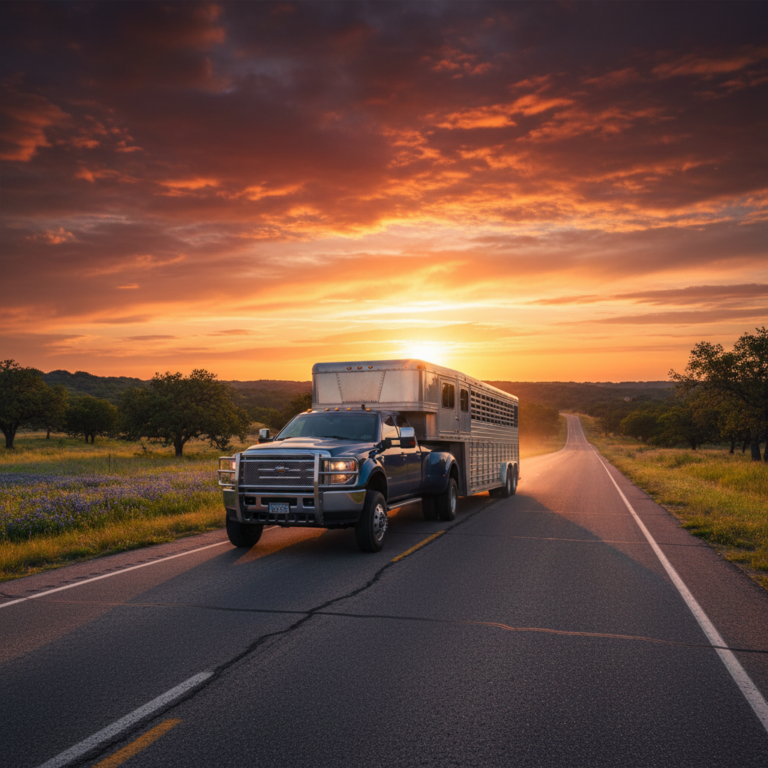
If you have spent any time on Texas highways, you know we do not mess around when it comes to towing. Whether it is pulling a bass boat down to Lake Travis, hauling a horse trailer to a cutting horse competition in Fort Worth, or towing an RV through the Hill Country, Texans need trucks that can handle serious weight in serious heat.
I have been in the automotive business for fifteen years now, and I have helped hundreds of folks find the right truck for their towing needs. The question I hear most often? What is the best truck for towing in Texas? The answer depends on what you are hauling and how often you are doing it.
In this guide, I will break down the top 7 trucks for towing in 2025, explain what those towing capacity numbers actually mean, and help you figure out which rig makes sense for your situation. Let us get into it.
Understanding Towing Capacity: What the Numbers Mean
Before we dive into specific trucks, let us talk about what those big towing capacity numbers actually mean. Because here is the truth: that maximum towing number on the window sticker? Most folks will never use it. But understanding these specs will keep you safe and help you buy smarter.
Conventional Towing vs. Fifth-Wheel/Gooseneck
There are two main ways to tow in Texas:
- Conventional towing: Uses a ball hitch in your truck bed or a receiver hitch. This is how you pull most boat trailers, utility trailers, and smaller travel trailers.
- Fifth-wheel/gooseneck towing: Uses a hitch mounted in the truck bed directly over the rear axle. This setup handles heavier loads like large RVs, horse trailers, and equipment trailers because it distributes weight more evenly.
The reason this matters: trucks often have higher towing capacities for gooseneck setups than conventional hitches. When you see a truck rated at 40,000 lbs, that is typically with a gooseneck configuration.
Payload Capacity and GVWR
Here is where a lot of folks get tripped up. Towing capacity is how much your truck can pull behind it. Payload capacity is how much weight you can put in the truck, including passengers, cargo, and the tongue weight of your trailer.
Your truck GVWR (Gross Vehicle Weight Rating) is the maximum total weight your truck can handle when fully loaded. Go over this number, and you are asking for trouble: worn brakes, stressed suspension, and unsafe handling.
The 10-15% Tongue Weight Rule
The tongue weight is how much downward force your trailer puts on the hitch. For safe towing, this should be 10-15% of your total trailer weight.
When towing 5,000 lbs or more, you will want a weight distribution hitch. These systems redistribute tongue weight across all four wheels of your truck, improving stability and handling. Most truck owner manuals require them once you hit that threshold.
One more thing: Texas does not require a special license for recreational towing under 26,000 lbs. Your standard Class A driver license covers most boats, RVs, and horse trailers.
Top 7 Best Trucks for Towing in Texas
Alright, let us get to the good stuff. I have ranked these trucks based on maximum towing capacity, but I will also tell you what they are actually best suited for in real-world Texas conditions.
1. Ford F-450 Super Duty: The Heavy-Hauling Champion (40,000 lbs)
When you absolutely need to pull everything including the kitchen sink, the F-450 is your truck. With the 6.7L High Output Power Stroke V8 turbo-diesel and the High-Capacity Gooseneck Tow Package, this beast tops out at 40,000 lbs of towing capacity.
That maximum number requires the Regular Cab 4×2 dually configuration, which gives you a longer wheelbase and dual rear wheels for stability. For Texas ranchers hauling heavy equipment or horse trainers moving multiple horses to competitions, this is the gold standard.
The Power Stroke diesel delivers 500 horsepower and 1,200 lb-ft of torque. That low-end torque is what gets heavy loads moving without straining the drivetrain. For specs on specific configurations, check the Ford official towing guides.
2. Ram 3500 HD: Cummins Power and Comfort (36,610 lbs)
The Ram 3500 HD with the legendary 6.7L High Output Cummins straight-six turbo-diesel offers 36,610 lbs of maximum towing in the Regular Cab 4×4 configuration. That Cummins engine has a cult following for good reason. It has been refined for decades and has a reputation for going 400,000+ miles with proper maintenance.
What sets Ram apart is the interior. Even in heavy-duty trucks, Ram cabin feels more like a luxury vehicle than a work truck. If you are spending long hours pulling a trailer across Texas, that comfort matters.
The available rear air suspension keeps your truck level when loaded, which I have found makes a real difference when hitching up and during long hauls. See the Ram towing and payload capacity guide for detailed specs.
3. GMC Sierra 3500 HD: Premium Heavy-Duty Performance (36,000 lbs)
The Sierra 3500 HD tops out at 36,000 lbs of conventional towing with the Duramax diesel. GMC positions itself as the premium option in GM lineup, and you will notice it in the cabin materials and technology features.
The MultiPro tailgate is genuinely useful when loading and unloading. The CarbonPro bed (available on upper trims) will not dent or scratch, which matters if you are hauling equipment regularly. For Texas buyers who want heavy-duty capability with more refinement, the Sierra delivers.
4. Chevrolet Silverado 2500 HD: Duramax Diesel Value (22,500 lbs)
Here is my sleeper pick. The Silverado 2500 HD with the 6.6L Duramax V8 diesel offers 22,500 lbs of maximum towing with a starting price in the mid-40k range. That is serious capability without the price tag of the one-ton trucks.
For most Texas towing needs: travel trailers, medium horse trailers, bass boats, utility equipment, 22,500 lbs is more than enough. You are getting the same proven Duramax engine and Allison transmission as the 3500 HD in a more maneuverable package.
The Chevrolet trailering and towing guide breaks down exactly which configurations get you maximum capacity.
5. Ford F-150: Best Half-Ton Towing Leader (13,500 lbs)
If you do not need heavy-duty capability but still want serious towing, the F-150 with the 3.5L EcoBoost V6 and Max Trailer Tow Package leads all half-ton trucks at 13,500 lbs.
That twin-turbo EcoBoost makes 400 horsepower and 500 lb-ft of torque. For a gas engine, that is impressive. The Pro Power Onboard generator (available on most trims) lets you run power tools or camp equipment right from the truck bed.
The F-150 is America best-selling truck for a reason. It is versatile enough to be a comfortable daily driver while still pulling a 25-foot travel trailer to Big Bend for the weekend.
6. Chevrolet Silverado 1500: Versatile Daily Driver (13,300 lbs)
The Silverado 1500 with the 6.2L V8 and Max Trailering Package hits 13,300 lbs of towing capacity. That puts it just behind the F-150, but it is still plenty for most half-ton needs.
What I like about the Silverado is the available 2.7L turbo four-cylinder that can actually tow 14,000-16,800 lbs depending on configuration. That is right: a four-cylinder pulling more than the V8 in certain setups. The technology has come a long way.
J.D. Power gave Chevrolet trucks strong reliability scores, with the brand scoring 174 problems per 100 vehicles, better than average for the segment.
7. Ram 1500: Smooth-Riding Half-Ton Workhorse (12,750 lbs)
The Ram 1500 with the 5.7L HEMI V8 and eTorque mild hybrid system tops out at 12,750 lbs. That is the lowest on this list, but here is the thing: the Ram 1500 rides better than any other half-ton truck on the market.
The available rear air suspension and coil-spring rear setup (instead of leaf springs) give you a smooth, comfortable ride whether you are loaded or empty. If you are doing mixed-use driving: commuting during the week and towing on weekends, the Ram comfort is hard to beat.
Diesel vs. Gas: Which Engine Is Best for Texas Towing?
This is the question I get asked more than any other. And the honest answer? It depends on what and how often you are towing.
Diesel Advantages: Torque and Efficiency
Diesel engines dominate heavy towing for one main reason: torque. Diesel motors make their peak torque at low RPM, which means they can get heavy loads moving without revving high and stressing the drivetrain.
Here is what that means in practice:
- Better fuel efficiency under load: Gas engines lose 40-50% of their fuel economy when towing heavy. Diesels lose much less.
- Lower transmission temperatures: Less strain at highway speeds means your transmission stays cooler, critical in Texas summers.
- Stronger resale value: Diesel trucks hold a 8,000-14,000 dollar premium over equivalent gas trucks when it is time to sell.
If you are regularly towing over 10,000 lbs or making long-distance hauls, diesel is worth the upfront premium.
Gas Engine Benefits: Lower Cost and Simpler Maintenance
Gas trucks cost less to buy, less to maintain, and you can fill up anywhere. If you are towing occasionally, a few weekends a year to pull the boat or make a furniture run, gas makes more sense financially.
Modern gas engines like Ford 3.5L EcoBoost and GM 6.2L V8 make plenty of power for moderate towing. You do not need a diesel to pull a 5,000 lb boat trailer to the lake.
Hot Weather Performance Considerations
Texas heat is brutal on trucks working hard. Diesel engines generally handle sustained loads in hot weather better than gas engines because they are designed for commercial use. But modern gas trucks with upgraded cooling packages do just fine for recreational towing.
The key is getting the factory towing package, which includes upgraded cooling systems designed for this kind of work.
Essential Towing Features for Texas Conditions
When you are truck shopping, these are the features that matter for towing in Texas heat and distances.
Towing Packages and What They Include
Every manufacturer offers some version of a Max Tow or Trailer Tow package. These typically include:
- Upgraded radiator and transmission cooler: Critical for Texas summers
- Higher-capacity rear axle: Handles heavier tongue weights
- Trailer brake controller: Integrated into the dash, not aftermarket
- Extended tow mirrors: See around your trailer
- Trailer hitch receiver: Usually Class IV or higher
Do not skip the factory towing package to save money. Aftermarket components rarely match factory-integrated systems.
Transmission Coolers for Hot Climate
Transmission heat is what kills trucks during towing. Texas highway driving in July with a loaded trailer is about as demanding as it gets. Factory auxiliary transmission coolers are sized for this kind of work. Aftermarket units often are not.
Watch your transmission temperature gauge when towing. If you see temps climbing above 200 degrees F regularly, pull over and let things cool down.
Brake Controllers and Trailer Brake Integration
Any trailer over about 3,000 lbs should have its own brakes. Your truck brake controller tells the trailer brakes when and how hard to engage. Integrated controllers (built into the truck from the factory) work better than aftermarket units because they are calibrated to the truck ABS system.
Modern trucks also offer trailer-specific driving modes that adjust throttle response, shift points, and stability control for towing. Use them. They work.
What Texans Actually Tow: Real-World Use Cases
Let me break down what truck makes sense based on what you are actually hauling.
RV and Travel Trailers (4,000-15,000 lbs): Half-tons can handle smaller travel trailers, but bump up to a 2500 HD if you are pulling anything over 25 feet. Large fifth-wheel RVs need one-ton trucks with gooseneck hitches.
Horse Trailers (4,000-20,000 lbs): A two-horse bumper-pull trailer works with a half-ton. Four to six horses? You need a 2500 or 3500 HD. Eight-horse trailers and living quarter trailers require one-ton dually trucks.
Utility and Equipment Trailers: Depends on what you are hauling. Lawn equipment and ATVs? Half-ton is fine. Skid steers and excavators? Heavy-duty all the way.
Safety Tips for Towing in Texas
Towing safely comes down to setup, preparation, and awareness. Here is what I tell everyone.
Weight Distribution and Proper Setup
Get your weight distribution right. Tongue weight should be 10-15% of trailer weight. Load heavy items low and forward in the trailer. Use a weight distribution hitch for anything over 5,000 lbs.
Your truck and trailer should both sit level when properly loaded. If your truck nose is pointing up, you have got too much tongue weight. If the tail is squatting, something is wrong with your setup.
For detailed guidance on proper setup, this comprehensive towing safety guide covers everything from weight distribution to tire pressure.
Pre-Trip Safety Checklist
Before every tow, run through this quick checklist:
- Check tire pressure on both truck and trailer (trucks often need higher PSI when towing, check your owner manual)
- Inspect hitch connections: ball/coupler tight, safety chains crossed, breakaway cable attached
- Test lights: brake lights, turn signals, running lights
- Verify brake controller: manual test before you leave the driveway
- Secure the load: nothing shifting, tailgate or doors latched
Takes five minutes and could save your life.
Texas Highway Driving Considerations
Texas highways mean long distances, high speeds, and unpredictable crosswinds. Give yourself more following distance than you think you need. Trailers take longer to stop. I recommend at least one second of following distance for every 10 feet of combined truck and trailer length.
Watch for crosswinds, especially on I-10 in West Texas and I-20 through the Panhandle. If your trailer starts to sway, ease off the throttle. Do not brake hard. Let the truck and trailer straighten out naturally.
And keep an eye on that transmission temperature gauge during summer towing. If you are climbing a long grade and temps are rising, slow down or pull over.
Reliability and Owner Satisfaction: What the Data Shows
Here is the honest truth about truck reliability in 2025: they are all about the same. Consumer Reports rated all major brands, Ford, Ram, Chevy, GMC, at 2 out of 5 for full-size truck reliability. Nobody is perfect.
That said, there are some differences worth noting:
- Chevrolet and GMC scored 174 problems per 100 vehicles in J.D. Power initial quality study, better than average
- GMC Sierra 1500 rated Great for reliability by J.D. Power
- Ford F-150 rated Average reliability
- Ram 1500 owners report high satisfaction with ride quality and interior
For high-mileage towing, diesel engines generally hold up better over the long haul. The Cummins and Duramax diesels both have strong reputations for 300,000+ mile longevity with proper maintenance.
Choosing Your Perfect Texas Towing Truck
Let me bottom-line this for you:
- Heavy commercial hauling, large horse trailers, fifth-wheel RVs over 20,000 lbs: Ford F-450 or Ram 3500 HD
- Regular heavy towing, mid-size horse trailers, large travel trailers: Silverado 2500 HD offers the best value
- Occasional towing, boats, smaller trailers, daily driver needs: F-150, Silverado 1500, or Ram 1500
If you tow regularly and go over 10,000 lbs, diesel is worth the extra cost. If you are pulling the boat a few weekends a year, stick with gas and put the savings toward a nice fish finder.
Here is my best advice: before you buy, test-tow. Dealers will often let you hitch up your actual trailer and take a truck for a real-world test drive. Nothing beats feeling how a truck handles your specific load on your specific roads.
Trucks are a serious investment in Texas. Take your time, do the research, and match the capability to your actual needs. A properly matched truck and trailer setup will serve you well for years. And there is nothing quite like pulling into the lake with a boat behind you or watching your horses unload safely after a smooth haul across the state.
That is what the best trucks for towing in Texas are all about.