Walk into any Texas dealership asking about trucks or SUVs, and you’ll hear the terms 4WD and AWD thrown around like they’re interchangeable. They’re not. I’ve spent fifteen years helping folks figure out which drivetrain actually fits their life, and I can tell you – picking the wrong one costs you money, capability, or both.
Here’s the thing: the 4WD vs AWD difference isn’t just about marketing speak. These are fundamentally different systems built for different purposes. Let me break it down so you can make a smart choice for your Texas driving needs.
What’s the Real Difference Between 4WD and AWD?
At the core, both systems send power to all four wheels. That’s where the similarity ends.
AWD (All-Wheel Drive) works automatically in the background. You never touch a button or flip a switch. The system constantly monitors traction and sends power where it’s needed. Think of it as a smart assistant for your tires.
4WD (Four-Wheel Drive) requires you to engage it manually – usually with a knob, lever, or button. When activated, it locks the front and rear axles together so they rotate at the same speed. This gives you maximum traction but comes with important limitations.
The key mechanical difference? 4WD systems use a transfer case that physically locks the driveshafts together. AWD systems use differentials and computer-controlled clutches to distribute torque smoothly. This distinction matters more than most salespeople will tell you.
How All-Wheel Drive (AWD) Works
AWD systems continuously monitor wheel speed and grip. When the computer detects one wheel slipping, it automatically redirects torque to wheels with better traction. This happens in milliseconds without any input from you.
Full-Time vs Part-Time AWD Systems
Full-time AWD powers all four wheels constantly. A center differential allows the front and rear driveshafts to turn at different speeds, which is necessary for making turns on pavement. This is what you’ll find in most luxury SUVs and performance vehicles.
Part-time AWD normally drives only the front wheels. When sensors detect slip, the system engages the rear wheels automatically. Most modern crossovers use this setup because it’s lighter and more fuel-efficient.
AWD Advantages for Texas Drivers
- Zero effort required: The system handles traction automatically, perfect for unexpected rain or that surprise ice storm
- Pavement-safe: Use it on any road surface without worrying about damage
- Better daily driveability: Smooth operation in stop-and-go traffic
- Improved wet weather handling: A real benefit during Houston’s flash floods or Austin’s unpredictable spring storms
AWD Disadvantages to Consider
- Fuel economy hit: Expect about 10% worse gas mileage compared to 2WD versions
- Limited off-road capability: Not designed for serious mud, rocks, or deep sand
- Higher purchase price: AWD adds $1,500-$3,000 to sticker price
- More complex maintenance: Additional components mean more potential repair costs down the road
How Four-Wheel Drive (4WD) Works
When you engage 4WD, the transfer case locks the front and rear driveshafts together. Both axles turn at the same speed, giving you maximum grip in low-traction situations. This is the system truck-based vehicles have used for decades.
Understanding 2H, 4-Hi, and 4-Lo Modes
Most 4WD vehicles give you three or four drive modes. Understanding them is critical – I’ve seen people destroy transfer cases because nobody explained this stuff properly. Here’s your breakdown for understanding 4WD modes:
- 2H (Two-High): Standard rear-wheel drive. Use this 95% of the time on normal roads. Best fuel economy.
- 4-Hi (Four-High): All four wheels engaged at a 1:1 ratio. Use on slippery surfaces like gravel, wet grass, or light mud. Safe at highway speeds.
- 4-Lo (Four-Low): All four wheels engaged with torque multiplication. Massive pulling power at very low speeds. Stay under 30 mph – this mode is for crawling through serious obstacles.
For a deeper dive into the mechanical side, check out how transfer cases work.
When to Use Each 4WD Mode
Use 4-Hi When:
- Driving on gravel or dirt roads
- Navigating wet grass or muddy fields
- Traveling on snow or ice-covered roads
- Pulling out of stuck situations on soft ground
Use 4-Lo When:
- Rock crawling or climbing steep grades
- Navigating deep mud or sand
- Towing heavy loads up steep inclines
- Any situation requiring maximum torque at low speed
4WD Advantages for Texas Drivers
- Superior off-road capability: Handles ranch roads, creek crossings, and Hill Country terrain
- Better towing capacity: 4WD trucks consistently outperform AWD vehicles when hauling heavy loads – essential if you’re shopping for the best trucks for towing in Texas
- More durable components: Built to handle abuse that would destroy an AWD system
- Beach driving capability: Crucial for Texas coastal areas like Padre Island
4WD Disadvantages and Warnings
- Must remember to engage/disengage: Leave it in 4WD on pavement and you’ll pay for it
- Heavier overall weight: Affects handling and acceleration
- More expensive to repair: Transfer cases and locking hubs aren’t cheap
- Overkill for most commuters: If you’re driving I-35 daily, you probably don’t need it
4WD vs AWD: Side-by-Side Comparison
| Feature | AWD | 4WD |
|---|---|---|
| Activation | Automatic | Manual (driver-controlled) |
| Best Use | On-road, all conditions | Off-road, extreme conditions |
| Pavement Safe? | Yes, always | Only in 2H mode |
| Fuel Economy Impact | ~10% reduction | Minimal (when in 2H) |
| Towing Capability | Moderate | Superior |
| Typical Vehicles | Crossovers, SUVs, sedans | Trucks, body-on-frame SUVs |
| Low-Range Gearing? | No | Yes (4-Lo mode) |
Which System is Right for Your Texas Driving Needs?
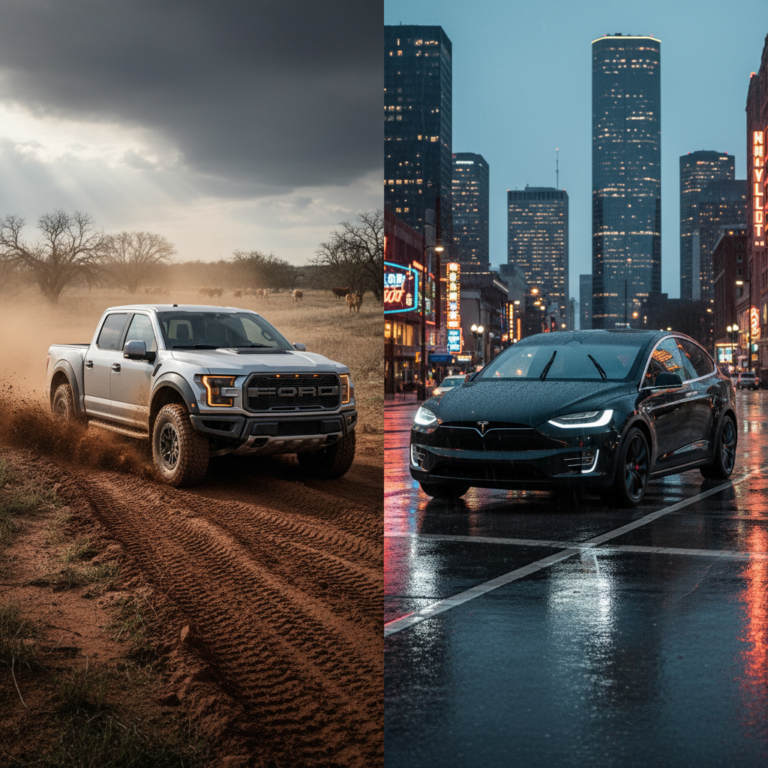
Here’s where I get real with you. Most folks buy more capability than they actually need. The guy in the lifted F-250 who’s never left pavement? He’s paying for 4WD he’ll never use. Let’s match the system to your actual life.
Choose AWD If You…
- Drive mainly on paved roads in urban or suburban areas
- Want better traction in rain without thinking about it
- Prefer crossovers or car-based SUVs
- Don’t tow heavy loads regularly
- Value convenience over maximum off-road capability
Choose 4WD If You…
- Own property with unpaved roads or regularly visit ranches
- Tow boats, trailers, or equipment over 5,000 lbs
- Hunt, fish, or recreate in remote Texas wilderness
- Need to navigate beach sand or creek crossings
- Work in construction, agriculture, or oil field services
Texas-Specific Driving Scenarios
Hill Country backroads: If you’re regularly exploring Fredericksburg-area ranch roads or hunting leases in the brush country, 4WD gives you peace of mind when conditions deteriorate.
Coastal beach driving: Padre Island and other Texas beaches require 4WD with aired-down tires. AWD crossovers get stuck in soft sand – I’ve helped push more than a few out.
Houston/Dallas commuting: Honestly? AWD handles everything these metros throw at you. The occasional ice storm or heavy rain doesn’t require 4WD capability.
Common Myths and Mistakes to Avoid
After years in this business, I hear the same misconceptions repeated constantly. Let me clear these up:
- Myth: AWD/4WD helps you stop better. False. These systems only help with acceleration and maintaining traction. Your brakes work exactly the same regardless of drivetrain. On ice, a 4WD truck stops just as poorly as a 2WD sedan.
- Myth: AWD means you don’t need winter tires. Wrong. AWD helps you go in snow, but tires determine how well you stop and turn. Good tires on 2WD beats bad tires on AWD every time.
- Myth: More driven wheels always equals safer. Not necessarily. The added weight and complexity can actually make some vehicles harder to control in emergencies.
- Mistake: Using 4WD on dry pavement. This damages your drivetrain. I can’t stress this enough – only engage 4WD on loose or slippery surfaces.
- Mistake: Leaving 4WD engaged “just in case.” Same problem. Switch back to 2H when you hit pavement.
Final Thoughts: Making the Right Choice
The 4WD vs AWD decision comes down to matching capability to your actual needs – not what you might do someday. Be honest about your driving habits.
Most Texas drivers – even those who think they need 4WD – do perfectly fine with AWD or even 2WD. If your truck never leaves pavement except for the occasional gravel parking lot, you’re paying for capability you’ll never use.
But if you’re pulling a boat to the lake every weekend, checking cattle on ranch roads, or heading to hunting leases where the last mile is pure mud? That’s when 4WD proves its worth. The towing capacity alone makes it worth considering.
Whatever you choose, understand what your vehicle can and can’t do. AWD won’t turn your crossover into a rock crawler. 4WD won’t magically make your truck stop better on ice. Drive within your vehicle’s limits and yours.
Got questions about which trucks or SUVs offer the best 4WD or AWD systems for your needs? I’m always happy to point you in the right direction. That’s what we’re here for.